AI Doesn't Have Opinions. It Has Sources.
Reddit, Wikipedia, YouTube, LinkedIn — the studies mapping millions of AI citations agree on the headliners. They also show that every engine reads a different web, that your vertical has its own map, and that the map gets redrawn overnight.
On February 9 this year, someone in the United States asked ChatGPT a question, read the answer, and noticed a small card underneath it labeled Sponsored. Nobody had seen one before. Two hundred days later, OpenAI said the ad business behind that card was already running at a billion dollars a year. Google's search ads took about four years to get there.
That speed is what everyone is talking about. We think the more useful question is simpler: what does that card actually buy you?
Look closely and the answer is a little surprising. The brand paying for the ad shows up in the answer above it less than 4% of the time. The paid layer and the organic layer of ChatGPT barely touch. Everything else in this post follows from that.
What the ad looks like
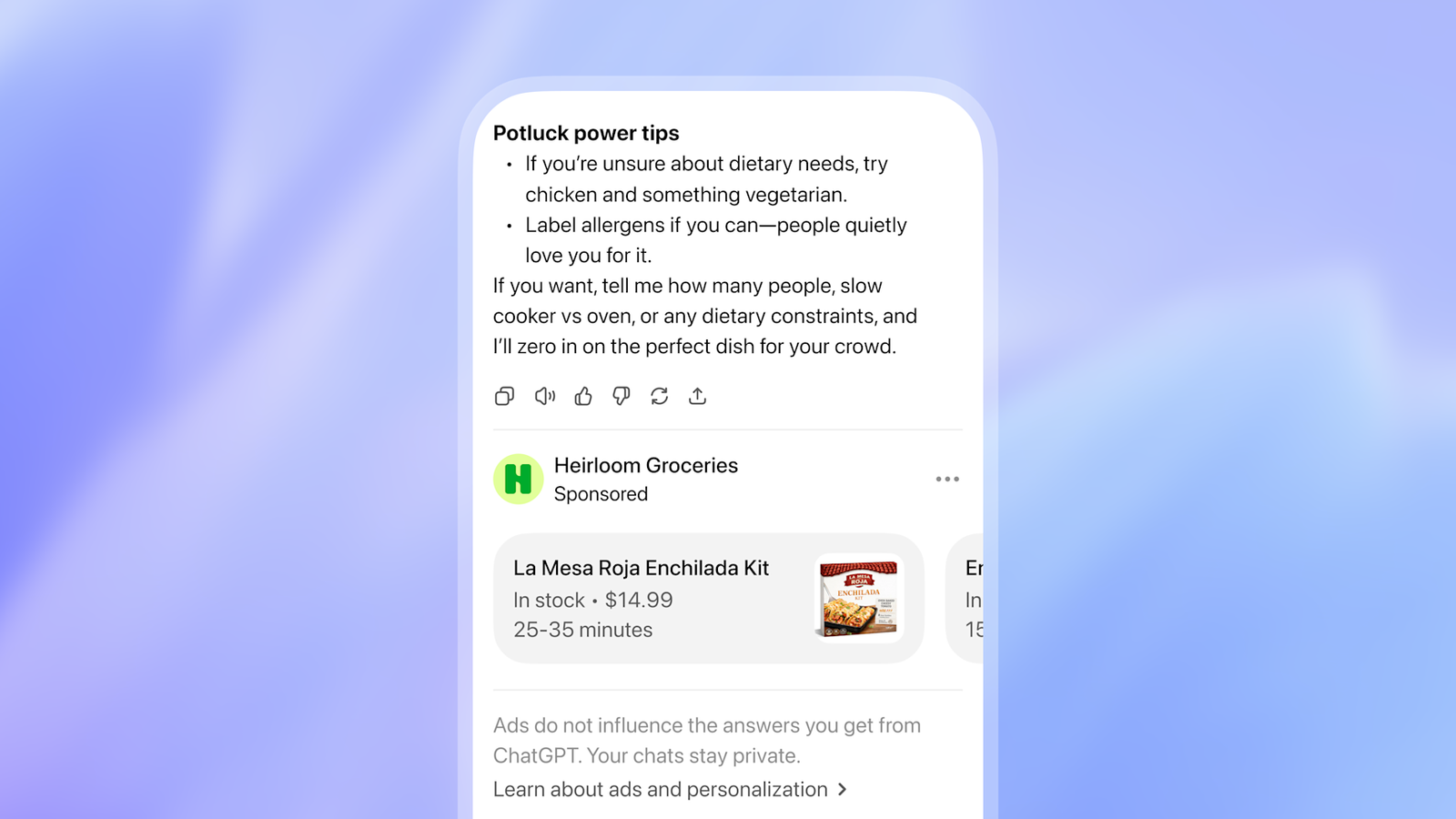
OpenAI's own example. The answer finishes, then a labeled card from an advertiser. Source: OpenAI.
That is the whole format, at least for now. The answer ends. Beneath it sits a card with the advertiser's name, a Sponsored label, and one or two product tiles: headline, image, price, link. Under that, a line reminding you that ads don't influence the answer and that your chats stay private. An interactive version, where you can ask ChatGPT questions about the ad without leaving the thread, is being tested with a handful of enterprise advertisers.
Who sees it. Logged-in adults on the Free and Go plans. Plus, Pro, Business and Enterprise never do. That still covers nearly all of ChatGPT's roughly 900 million weekly users, which is the point.
How it gets picked. Not by keyword. Advertisers choose intent categories, geographies and, since summer, custom audiences. ChatGPT matches those against the topic of the conversation and, if you allow it, your past chats, and it picks the ad after the answer is written. Advertisers get aggregated views and clicks, never the conversation. No ads appear on health, politics or other sensitive topics, and none for users under 18.
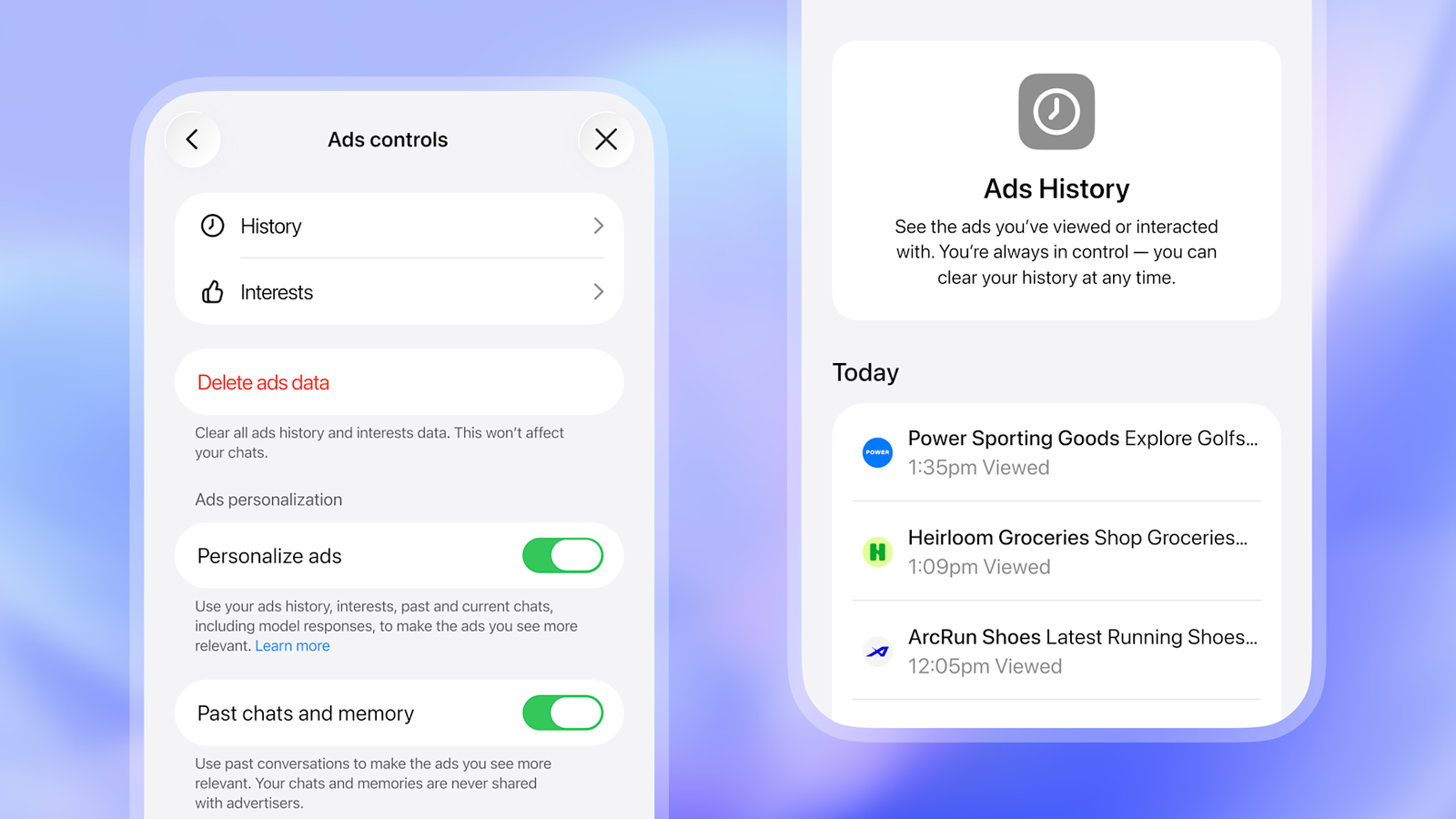
Users can review, delete and switch off ad personalization. Worth knowing before you assume you can target past behavior. Source: OpenAI.
What it costs, and how quickly that changed
The pilot opened for big budgets only. It did not stay that way for long.
| Date | What changed |
|---|---|
| Feb 9, 2026 | First US ads; $60 CPM guidance; commitments of $200,000 and up |
| Apr 13 | Minimum drops to $50,000; negotiated CPMs reported at $25 to $45 |
| May 5 | Self-serve Ads Manager opens in the US; no minimum at all |
| Aug | UK, Mexico, Brazil, Japan, South Korea, then 31 European countries and India |
| Aug 31 | $1 billion run rate; self-serve opens across Europe, India, the Middle East and North Africa; 52 advertiser countries |
| Sep 10 | Ads for image and audio generators that compete with OpenAI's own are cut off; Adobe loses its Firefly campaigns without notice |
Today a US business can start at $25 a day. Click bids are guided at $3 to $5, and advertisers running their own tests report paying between $1.72 and $2.74. The Ads Manager now has reach, click and conversion objectives, an on-site Pixel and a server-side Conversions API. By August, most of the money was flowing through cost-per-click.
A few doors stay closed: adult content, gambling, alcohol and tobacco, crypto, politics and legal services are prohibited, and finance and healthcare need approval. Turkey, as of the end of August, is not on the available list or the "coming soon" list. We come back to that.
Is it working?
Depends who you ask.
OpenAI's numbers are loud. A billion-dollar run rate, a plan for $2.5 billion this year and $11 billion next, and a story told to investors that ends at $100 billion in 2030. The inventory backing that is real: SE Ranking ran 50,006 commercial prompts in August and found a paid card under one in four of them, from more than a thousand advertisers. The early heavy spenders are the ones you would guess, SaaS companies and comparison sites, HubSpot and Semrush next to Top10 and BestMoney.
The advertisers' side is quieter. Reported click-through rates sit between 0.5% and 1.8%. One Adthena client measured 0.91% where Google search does 6.4% in the same category. One enterprise had managed to spend 3% of a $250,000 budget after several weeks, because ChatGPT couldn't find enough matching conversations. The best public case we found, a 15-day test by Opascope, returned 1.49 times its spend. Encouraging, small, and not yet a pattern.
Then there is trust. In an Ipsos survey this February, 63% of US adults said ads in AI search would make them trust the results less. OpenAI says its own trust metrics haven't moved. Perplexity looked at the same question and walked away from ads in February with one line: "We are in the accuracy business."
Our read: the audience is enormous, the inventory is real, and the craft of buying it is about six months old. Treat every benchmark you see, including the ones in this post, as a first draft.
The number that should organize your budget
Here it is. SE Ranking: the advertiser behind a ChatGPT ad is also cited in the answer above it in 3.63% of placements. Seer Interactive, different sample, different method: the advertiser is mentioned in the answer 7.3% of the time and cited as a source 3.3% of the time.
This isn't a bug OpenAI will patch. It is how the thing is built.
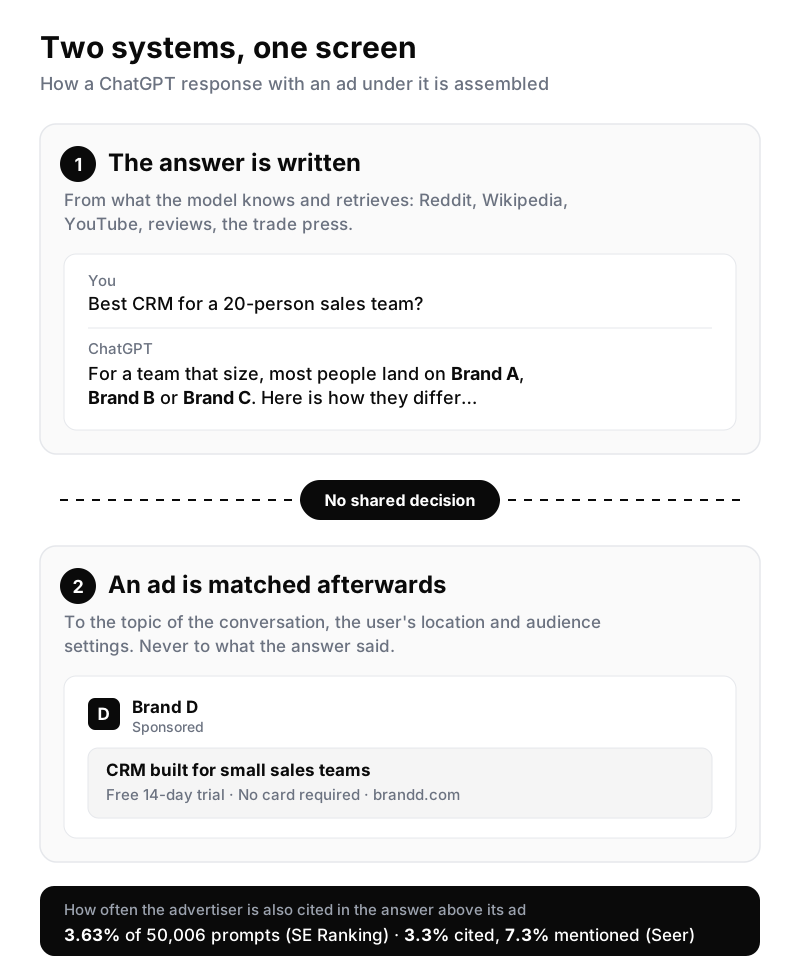
The ad is placed after the answer is written. You can pay for the box beneath the verdict. You cannot pay for the verdict.
Three things follow, and each is a line in your budget.
Buying the slot doesn't buy the recommendation. A brand missing from the answer can pay to sit under it. The reader sees "most people land on A, B or C," then a card for D. That's not nothing; it's how comparison sites are already spending. But it is a different product from being C.
Being recommended doesn't protect the slot. Seer's sharpest observation was that most brands haven't claimed their own branded prompts. When someone asks ChatGPT about you by name and the answer is glowing, a competitor can still buy the card underneath. Conquesting, the oldest trick in paid search, is back, and the inventory is cheap because so few brands have noticed.
One company controls both layers. On September 10, OpenAI stopped selling ads for image and audio tools, days after launching its own. Adobe's search lead described ChatGPT as "narrowing both the paid and organic discovery pathways" in categories it now competes in. If your category is one OpenAI might enter, your paid plan and your organic plan share a single point of failure.
Where the other engines stand
| Engine | Paid layer, September 2026 |
|---|---|
| ChatGPT | Ads on Free and Go in 52 countries; self-serve; CPM, CPC and conversion bidding |
| Google AI Overviews and AI Mode | Ads in roughly a quarter of AI results, up from about 5% in early 2025; offers and checkout inside AI Mode |
| Microsoft Copilot | Existing Microsoft Advertising campaigns can appear inside Copilot answers |
| Perplexity | Dropped ads in February 2026; subscriptions and shopping instead |
| Gemini app, Claude | No ads |
Google folds the ad into the answer surface; ChatGPT keeps it outside and says so loudly. For a brand, both roads lead to the same place: the ad and the recommendation are separate assets, made by separate systems, measured separately.
A note on Turkey
In Turkey, ChatGPT carries 94.49% of AI referral traffic, the highest single-engine share anywhere. ChatGPT Go is available there. Ads are not, and Turkey isn't on the announced roadmap.
That combination is unusual. When the switch flips, almost the entire Turkish AI-search audience becomes ad-eligible on the same day, and the first advertisers in the auction will be the ones who already know which prompts they are missing from. Until then, Turkish brands have exactly one lever inside ChatGPT: the organic answer. It is worth pulling while it is the only one that works.
What to do
- Map the organic layer before you spend. For every prompt that matters, know whether the answer names you, names a competitor, or names no one. Ads where you're absent are an offensive buy. Ads where you're already recommended are insurance against conquesting. Without the map, every dollar is a guess.
- Claim your own name. Branded, "versus" and "alternatives to" prompts are the cheapest inventory and the most dangerous to leave open.
- Read the answer above your ad. If the model describes you badly or wrongly, an ad underneath pays to be seen next to a bad verdict, in front of people who already distrust the pairing. Fix the answer first.
- Measure the two layers separately. Pixel and Conversions API for the ad. Mention share and citation share for the answer. Never let one report the other's success.
That first step is the one most teams skip, because until now nobody sold them a reason to look. The Lens measures the organic layer prompt by prompt, engine by engine, against named competitors: which answers include you, which don't, and who took your place. That's the map that tells a media team where an ad is defensive, where it is wasted, and where it is the only option. The PR Factory builds the source material that moves the answer itself, the part no auction sells. And The Shield watches sentiment in the answer layer so you hear about a bad verdict before you pay for the box beneath it.
ChatGPT now sells the slot. The answer is still earned. Measure the second before you pay for the first.
Sources
- OpenAI — "Testing ads in ChatGPT"; "ChatGPT Ads expands across Europe", Aug 19, 2026; "A milestone in expanding access to AI", Aug 31, 2026; Help Center, "Ads in ChatGPT"; Ad policies
- Digiday — "OpenAI takes ChatGPT ads into Europe", Aug 19, 2026; "ChatGPT ads business hits $1 billion run rate", Aug 31, 2026
- Forbes / Yahoo Finance — ChatGPT Ads $1 billion run rate in 200 days, Aug 31, 2026
- eMarketer / The Information — OpenAI ad revenue projections 2026–2030, Apr 2026
- PPC Land — ChatGPT ad CPMs drop to $25, Apr 17, 2026
- MarTech — ChatGPT Ads adds conversion bidding and stronger measurement, 2026
- Search Engine Land — "ChatGPT Ads are expanding to 31 European countries", Aug 19, 2026; "Perplexity stops testing advertising", Feb 18, 2026
- PYMNTS / Bloomberg — OpenAI cuts off rivals' image and audio ads on ChatGPT, Sep 10, 2026
- SE Ranking — ChatGPT Ads Tracker, 50,006 commercial prompts, Aug 2026
- Seer Interactive — "Our Early View of ChatGPT Ads: 5 Initial Observations", updated Jul 28, 2026
- Campaign US / Adthena — "Underwhelming early returns for ChatGPT Ads", 2026
- Search Engine Journal / Ipsos — "Trust in AI search could drop with ads", Feb 2026
- Google — Marketing Live 2026: AI Mode ads, Direct Offers, native checkout
- Narron — "In Turkey, AI Search Has One Name", Aug 2026