Your Website Was Built for Human Eyes. Its Next Visitor Won't Have Any.
WebMCP is a W3C standard co-authored by Google and Microsoft engineers, previewed in Chrome and switched on by default across Shopify's storefronts in August. It lets AI agents operate your website instead of just reading it. GEO's next layer isn't visibility. It's operability.
The Lens Team · Narron ·
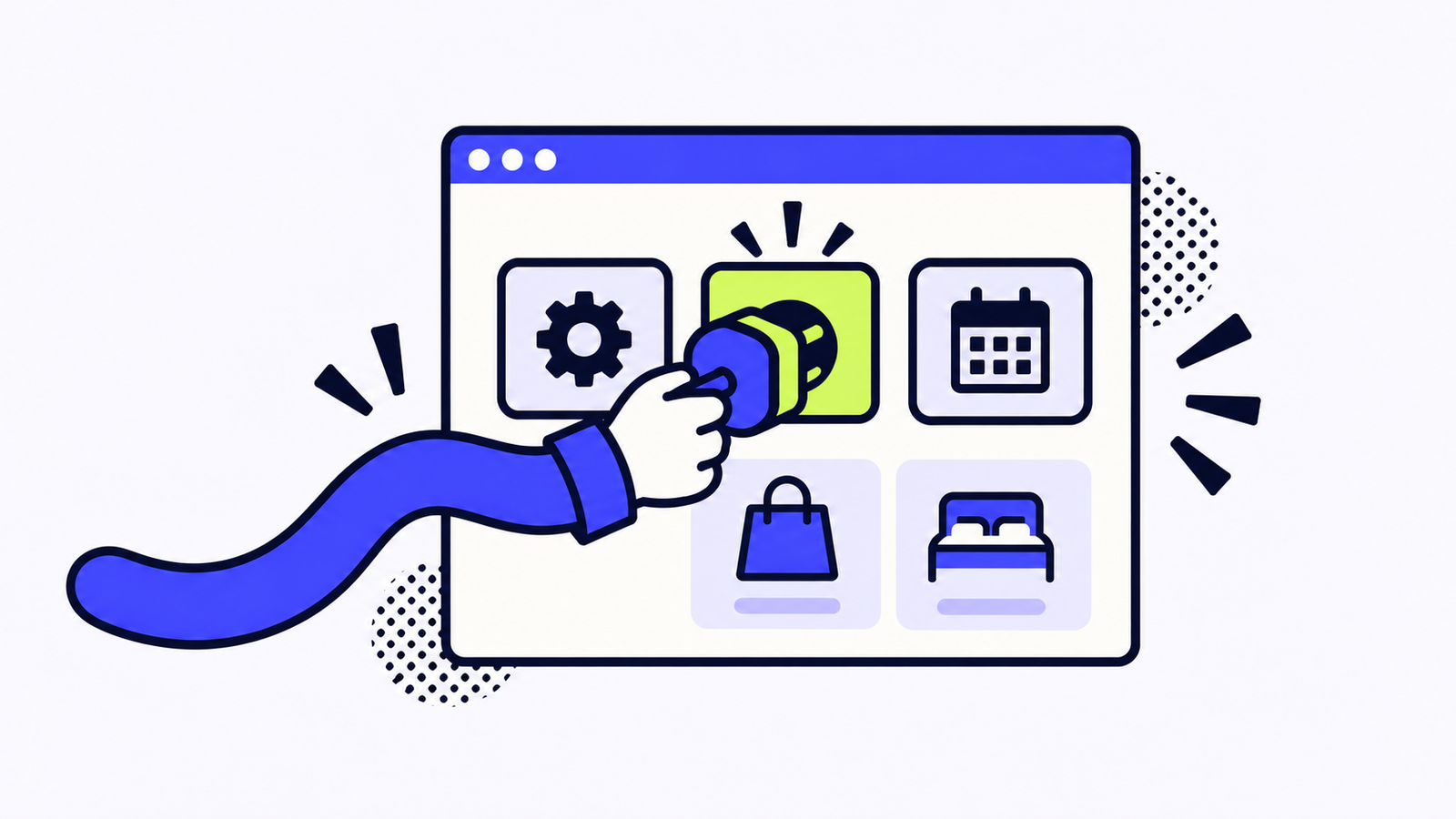
For two years, the GEO conversation has been about one thing: whether the machine reads you. Does the model know your brand? Does it cite your pages, and does it put you in the shortlist when a buyer asks for a recommendation? All of that happens at the answer layer. The agent reads the web, forms an opinion, and speaks.
In 2026, a second layer opened underneath it. The agent no longer just reads. It searches inventory, requests quotes, books tables, completes purchases. And in the past few months, the infrastructure for that behavior acquired something it never had before: a web standard.
It's called WebMCP. If your roadmap has a line item for AI visibility, it's about to need a second line.
The demand side arrived before the standard did
Agents acting on websites is not a forecast anymore; it's measured traffic. AI-referred visits to US retail sites grew 1,324% between October 2024 and May 2026, according to Adobe. OpenAI's "Buy it in ChatGPT" now reaches over a million Shopify merchants. Five competing agentic commerce protocols shipped within nine months of each other.
Until now, though, an agent "using" your website meant screen-scraping it: take a screenshot of the page, guess which button is Add to cart, fill the form, and hope the layout didn't change last Tuesday. That approach is brittle, slow and expensive. In early testing, a structured tool call costs somewhere between 20 and 100 tokens, while each screenshot round of interface guessing burns 2,000 or more.
The web has solved this kind of problem before. When mobile traffic became too big to ignore, we stopped pinch-zooming desktop sites, standardized responsive design, and Google made mobile-first indexing the default. WebMCP is the same move, this time for agents.
What WebMCP actually is
WebMCP (Web Model Context Protocol) is a proposal in the W3C Web Machine Learning Community Group, co-authored by engineers from Google and Microsoft. Think of it as the browser-native sibling of Anthropic's Model Context Protocol, the standard that went from launch in November 2024 to near-universal platform support, roughly half a billion monthly SDK downloads and more than 10,000 public servers by mid-2026.
The core idea: instead of an agent guessing at your interface, your page declares its capabilities as tools.
- Declarative path: annotate the HTML forms you already have with attributes like
toolnameandtooldescription. Existing sites become agent-compatible with minimal changes. - Imperative path: register richer tools in JavaScript via
navigator.modelContext.registerTool(), say asearchProducts()orrequestQuote()with a typed schema for inputs and outputs.
The agent discovers the tools, calls them with structured arguments, and gets structured results back. No pixel guessing. The browser sits in the middle as a secure proxy: same-origin policy applies, and sensitive tools require user confirmation before an agent can fire them.
As for where the standard actually stands: WebMCP shipped as an early preview behind a flag in Chrome 146, stable since March 2026. Microsoft's co-authorship makes Edge support likely. Firefox and Safari are in the working group but have shipped nothing, and the spec will change. This is mobile-first indexing in its 2015 phase. Early, in other words, and exactly the moment when the prepared brands started compounding.
Then Shopify flipped the default
On August 5, 2026, Shopify announced that every Liquid storefront exposes WebMCP tools automatically, with nothing for merchants to install or configure.
Consider what that looks like from your competitor's side of the market. Millions of storefronts became agent-operable overnight, by default, without a single merchant lifting a finger. Once operability is the default for the stores you compete with, "our site doesn't do that" stops being a neutral fact. In a market where the buyer's agent submits identical requests to five vendors at once, the site that answers in schemas gets compared. The site that requires a human gets skipped.
The first era of GEO decided whether the agent mentions you. The next one decides whether the agent can do business with you.
The stack it belongs to
WebMCP is one layer of a standards stack that hardened remarkably fast. Since December 2025, most of it sits under the Linux Foundation's Agentic AI Foundation, which counted 180 participating organizations as of May 2026:
| Standard | What it does | Origin |
|---|---|---|
| MCP | Connects agents to tools and data, the "USB port" | Anthropic, Nov 2024 |
| A2A | Agent-to-agent discovery and collaboration, v1.0 Apr 2026 | Google, now Linux Foundation |
| NLWeb | Makes sites conversational via Schema.org and RSS; every instance is an MCP server | Microsoft (R.V. Guha), May 2025 |
| AGENTS.md | A README for machines; 60,000+ projects within months | OpenAI, Google, Cursor et al. |
| WebMCP | Exposes your site's features as callable tools, in the browser | Google + Microsoft, W3C |
NLWeb's early adopters (Tripadvisor, Eventbrite, O'Reilly, Hearst, Allrecipes) signal where publishers are heading, though its implementation is still admittedly proof-of-concept grade. The direction of the stack as a whole, however, is unambiguous. The web is growing a machine-facing interface: standardized, versioned and governed.
What this means for GEO
The funnel now has two layers, and each one gates the other.
Visibility is the layer we've always measured. When the agent assembles a shortlist, is your brand in it? That remains the senior question. Operability without visibility is a beautifully instrumented shop on a street nobody walks down.
Operability is the new layer. When the agent tries to act, whether that's a quote, a stock check, a booking or a purchase, can it complete the task on your site? Visibility without operability is about to become its own failure mode: the model recommends you, the agent attempts the task, hits a wall of unlabeled buttons, and finishes the job with the competitor whose storefront answered in schemas. You won the mention and lost the transaction.
The playbook, in order:
- Keep the fundamentals first. Crawlable pages, clean structure, fresh Schema.org markup. The same hygiene that feeds AI citations also feeds NLWeb and tool discovery. Nothing about WebMCP replaces it.
- Inventory your tools. List the three to five actions on your site that actually make you money: search, quote, availability, booking, checkout. Those are your future tool registrations. If you're on Shopify, open the console, because you may already be exposing them.
- Watch, don't bet. The spec is flag-gated and will change. Experiment now; re-architect nothing yet.
- Measure the agent share. Start splitting AI-referred traffic from the rest today, so you can see the moment reading turns into doing.
And keep the order of operations straight. Operability decides whether the agent can transact with you, but mention share decides whether it ever tries. The Lens measures that first gate: which engines recommend you, on which prompts, against which competitors. So that when the agents start acting, they're acting on you.
Sources
- W3C Web Machine Learning Community Group — WebMCP proposal, working draft, 2025–2026
- Google Chrome — WebMCP early preview behind flag, Chrome 146, 2026
- Shopify — Automatic WebMCP tool exposure across Liquid storefronts, Aug 5, 2026
- Anthropic — Model Context Protocol, Nov 2024; ecosystem figures mid-2026
- Microsoft — NLWeb, Build 2025; Agentic AI Foundation (Linux Foundation), Dec 2025
- Adobe — AI-referred traffic to US retail, Oct 2024–May 2026
- Search Engine Land / LOCOMOTIVE — "WebMCP explained: inside Chrome 146's agent-ready web preview", 2026
- Discovered Labs — WebMCP technical guide and token-efficiency figures, 2026